Dennis L. Thompson
1848?–?
Dennis Thompson (1848?-?), Iowa College Preparatory Program 1867-73
Compiled by D. H. Kaiser, July 2026
"Uncertainty clouds the early life of Dennis Thompson, one of a small group of Black men who enrolled in the Iowa College Preparatory program in the 1860s. In a January 1872 filing with the Freedman’s Bank Thompson affirmed that he had been born in Missouri 26 years earlier (=1846), that his father’s name was Livi and that his mother was named Dorcas.1 No other details survive, but certainly both parents had been slaves, meaning that Dennis
himself had been born into slavery. As the Civil War played out in Missouri, the former slave volunteered to serve with Union troops, agreeing to a three-year term that began January 29,1864; however, because the “Govt [sic] no longer required” his services—the Confederate threat in Missouri and Arkansas had been quashed—Thompson was discharged October 15,1865 in De Vall Bluffs, Arkansas and received his payment ($106.20) November 2,1865 (Grinnell College Libraries Special Collections, Biographical Files 1800- , Box T).
Dennis Thompson apparently then made his way directly to central Iowa, first entering Grinnell records in the 1860s. One of the early Grinnell settlers, Rev. James L. Hill (1848-1931), late in life recalled that when he first began teaching in a school northeast of town one of his students was Dennis Thompson, “black as Erebus,” he thought (Grinnell Herald, July 29,1930). Indeed, when Thompson in 1864 volunteered to serve in a “colored” regiment of the Union Army, the record listed him as five feet, nine inches tall with black complexion, black hair, and black eyes (Grinnell College Libraries Special Collections,
Biographical Files 1800-, Box T). Described by Hill as the “contraband of war”—perhaps a reference to his having been a fugitive slave—Thompson, he said, “waded through snow and mud and attended [school] daily…” (Grinnell Herald, July 29,1930). Like his fellow former slave, George Washington Stith (1847?-1926), Thompson resided in Chester at the time, working for Jason W. Sherman (1826-91),2 one of the founders of the Chester community and the Chester Congregational Church (Grinnell Herald, June 16,1882). But exactly how Thompson found central Iowa remains unknown.
Dennis Thompson’s name first appears in the Catalogue of Iowa College 1867-68 (p. 7) as a Grinnell resident enrolled in the “preparatory department,” “studying languages.” The same appears in the next year’s catalog (p. 8), but in the 1869-70 catalog Thompson is identified as a member of the “second class” (p.7). The following year’s catalog invented a new category for students in the preparatory program—“Middle Class”—to which Dennis Thompson and a dozen other students were assigned (Catalogue of Iowa College 1870-71, p. 8)."
1 United States, Freedman's Bank Records, 1865-1874." Database with images. FamilySearch.
http://FamilySearch.org : 30 April 2026. Citing NARA microfilm publication M816. Washington, D.C.: National Archives and Records Administration, 1970.
2 Chester Congregational Church, Centennial Anniversary, June 20, 1965, pp. 8-9."
Instruction in the Preparatory program was not for the faint of heart. The pre-collegiate program, as the catalog pointed out, “is sufficiently extensive and thorough to enable those who complete it to pursue the regular collegiate studies with ease and success” (1869-70 Iowa College Catalog, p. 15). Two years of study required students to read Caesar, Cicero, and Virgil in Latin and complete two terms of Greek instruction before reading Xenophon’s Anabasis and Memorabilia in Greek. In addition, students would study American, Greek and Roman history, and do two terms of algebra (plus one review term) (ibid., pp. 15-16).
How well Dennis Thompson—a former slave who had been deprived of access to formal education—navigated this formidable curriculum is unclear, but he certainly did not proceed directly to the collegiate program at Grinnell. Instead, he interrupted his studies and left Grinnell (summer 1871?) to teach school for a year in Warren County, Mississippi, living at “Capt Willis place 13 miles from Vksbg [Vicksburg],” as confirmed by his Freedman’s Bank records. Thompson returned to Grinnell and the college’s preparatory program in 1872 (Grinnell Herald, July 3,1872). And then, for reasons unexplained, in 1873 he abandoned Grinnell again, this time enrolling at Kentucky’s Berea College, where the Catalogue of the Officers and Students of Berea College 1873 named him as one of eight “seniors” in the preparatory department (p. 9). Evidently, he made a good showing at Berea, because the following year’s catalog lists him not as a college freshman but rather as a college sophomore pursuing the classical curriculum (p. 4). Thompson later appears as one of seven juniors, but his home address now read as Richmond, Missouri (Catalog of Berea College 1877-78, p. 7). The 1878-79 Berea catalog declared Thompson a senior
pursuing the Literary Course instead of Classics that he had focused upon earlier (p. 7); at the 1879 commencement Dennis Thompson received the bachelor’s degree from Berea College.
The college graduate—by this time more than 30 years old—seems to have escaped notice for a few years, but no later than summer 1882 he returned to central Iowa. The Oskaloosa Herald in its June 1st issue told readers that “Dennis Thompson, colored, lectured at Wesley chapel, subject—What will we do with life?” The Herald applauded Thompson’s successful education at Berea, and remarked that he was “logical, forcible, and destined to make his mark in the world.” Moreover, the editors encouraged readers to help Thompson “pay the balance he owes Berea College.” A week or ten days later Thompson was in Grinnell, “reviewing the familiar scenes” (Grinnell Herald, June 9,1882). Sunday June 11 Thompson delivered to the Grinnell Congregational Church the same address he had given in Oskaloosa. If in Grinnell he solicited funds to pay for his education, the newspapers did not say but did remark that Thompson planned to enter Oberlin Theological Seminary that autumn to prepare himself for the ministry (Grinnell Herald, June 16,1882; The Signal, June 10, 1882).
How much money Thompson owed Berea College for his education is unknown. Beginning in 1892, Berea College charged no tuition for any admitted student.3 When Dennis Thompson attended, however, free tuition was not guaranteed. Tuition for up to 90 students was funded by endowment gifts, but all students paid room, board and miscellaneous charges, estimated in 1879 to cost between $33.75 and $40.25 for each of the college’s three terms. For those not receiving scholarships, tuition ran between $3 and $4 each term (Catalogue of Officers and Students of Berea College 1878-79, p. 26). Charges were somewhat lower when Thompson first entered Berea and we have no idea how much he was able to pay, but his total collegiate indebtedness might have reached $350 or $400.
An email message from a Berea College archivist reported that Thompson had indicated on school records that Joseph Blackwell was his “guardian/parent/sponsor” (email from Lori Myers-Steel, November 25, 2024). The 1870 U.S. Census for Grinnell identified Joseph Blackwell as a Black head of household who, with his wife Patsy, cared for 8 children who ranged in age from 24 to 3. Reporting his occupation as “day laborer,” Joseph claimed real estate worth $500 and personal property worth $300, totals significantly higher than those reported by other Black residents of Grinnell. These figures help explain why Thompson might list Blackwell as his guarantor at Berea, but how Blackwell and Thompson knew one another is not clear. Of course, in a community as small as Grinnell, every Black in town might have known every other Black. In addition, Joseph Blackwell told census officials that he had been born in Kentucky where he might have learned about Berea College and perhaps later told Thompson about it. Moreover, the Blackwells seem to have lived in Missouri since about 1850 as all their children but the oldest and the youngest had been born in Missouri, the same state which Thompson claimed as home. It is possible, therefore, that Thompson knew the Blackwells long before he reached Grinnell but confirming evidence is missing.
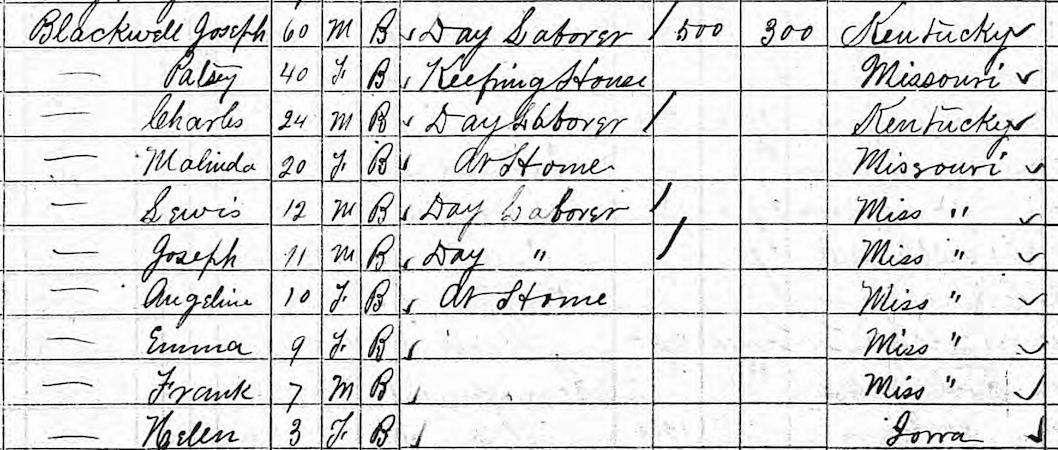
Extract from1870 US Census, Grinnell, Iowa
"Whatever the connection, by the time Dennis Thompson enrolled at Berea, both Joseph Blackwell and his wife, Patsy, were dead: Patsy died June 27,1872 and Joseph died June 14,1873, as the hand-written index to Hazelwood Cemetery confirms. Consequently,
neither could have helped support Thompson at Berea."
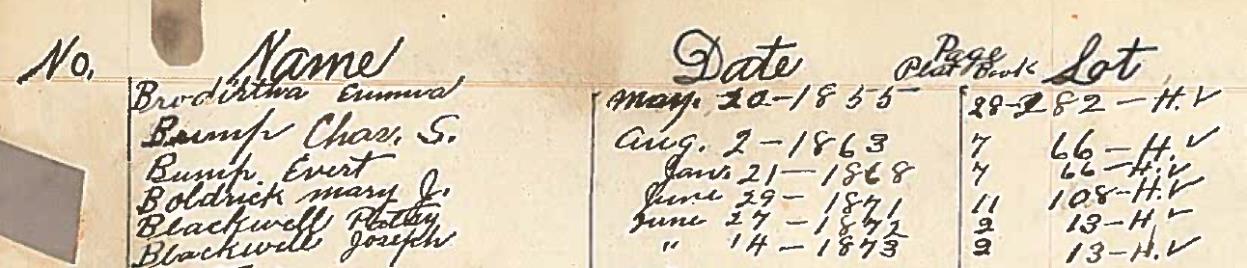
"Drake Community Library, Local History Archive, Records of Ladies Cemetery Association, Collection #183, Box #6"
"What happened to Dennis Thompson after his 1882 visit to Grinnell is hard to say. While in Grinnell Thompson announced an intention to enter Oberlin Seminary that autumn. However, the 1882 Oberlin catalog makes no mention of his name (Catalogue of themOfficers and Students of Oberlin College for the College Year 1882-83 [Chicago: Blakely, Marsh & Co., 1882]) and an Oberlin archivist wrote that she could find his name in no college record (email from Emily Rebmann, July 13, 2026). Apparently, Thompson was unable to fulfill his ambition of enrolling at Oberlin.
3 Kim Kobersmith, “The Work Behind the Promise,” Berea College Magazine Winter 2022
(https://magazine.berea.edu/since-1855/the-work-behind-the-promise/).
If he decided to do something else—teach, perhaps, or find another way to exploit his oratorical success—why does his name disappear from the news in those places where once he lived and thrived? It is possible that the records that confirmed his presence elsewhere are lost or inaccessible, but it is hard to believe that supporters in Grinnell or Berea did not mention Thompson’s successes in the years after 1882 and pass that news along to local newspapers.
Of course, it might be that the absence of mention is mute evidence of Thompson’s death, but nothing in the publications of Grinnell—town or college—reports his death, nor does any surviving record from Berea College, an omission hard to reconcile with Thompson’s academic success. Surely an obituary would remember this remarkable former slave who mastered Greek and Latin and earned a bachelor’s degree, an accomplishment that matched the academic success of Hannibal Kershaw, the first Black to graduate from Grinnell College. But no such obituary or death notice for Dennis Thompson survives.
It is possible that Thompson’s remains lie interred in Grinnell’s Hazelwood Cemetery where, it seems, one decapitated gravestone remembers a certain “Thompson” who was born December 8,1848 and died August 10,1891.4 The upper part of the stone where a given name presumably once stood is missing, but according to records at Berea College Dennis Thompson was born in 1848 (although other records offer different dates of birth). There is no evidence for a death date for Dennis Thompson but, since we know no death date, almost any date before 1945 is possible. So, Dennis Thompson certainly could have
died in 1891. Might this stone mark the grave of Dennis Thompson?"
Efforts to locate the stone and perhaps discover clues to the identity of the person it remembers have so far been unsuccessful. But even if we learn that this gravestone does mark the final resting place of Dennis Thompson, the fact that his death went unreported and unlamented in Grinnell papers offers sad testimony to the unnoticed demise of a remarkable man, one of the first Black men to study successfully at the College’s Preparatory Program.
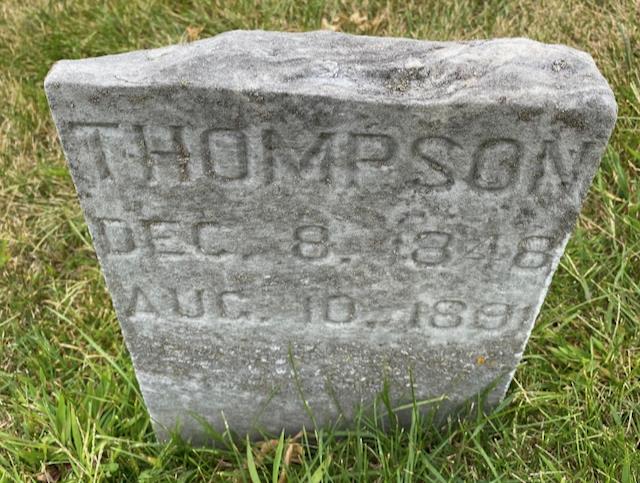
4 https://www.findagrave.com/memorial/215113815/thompson
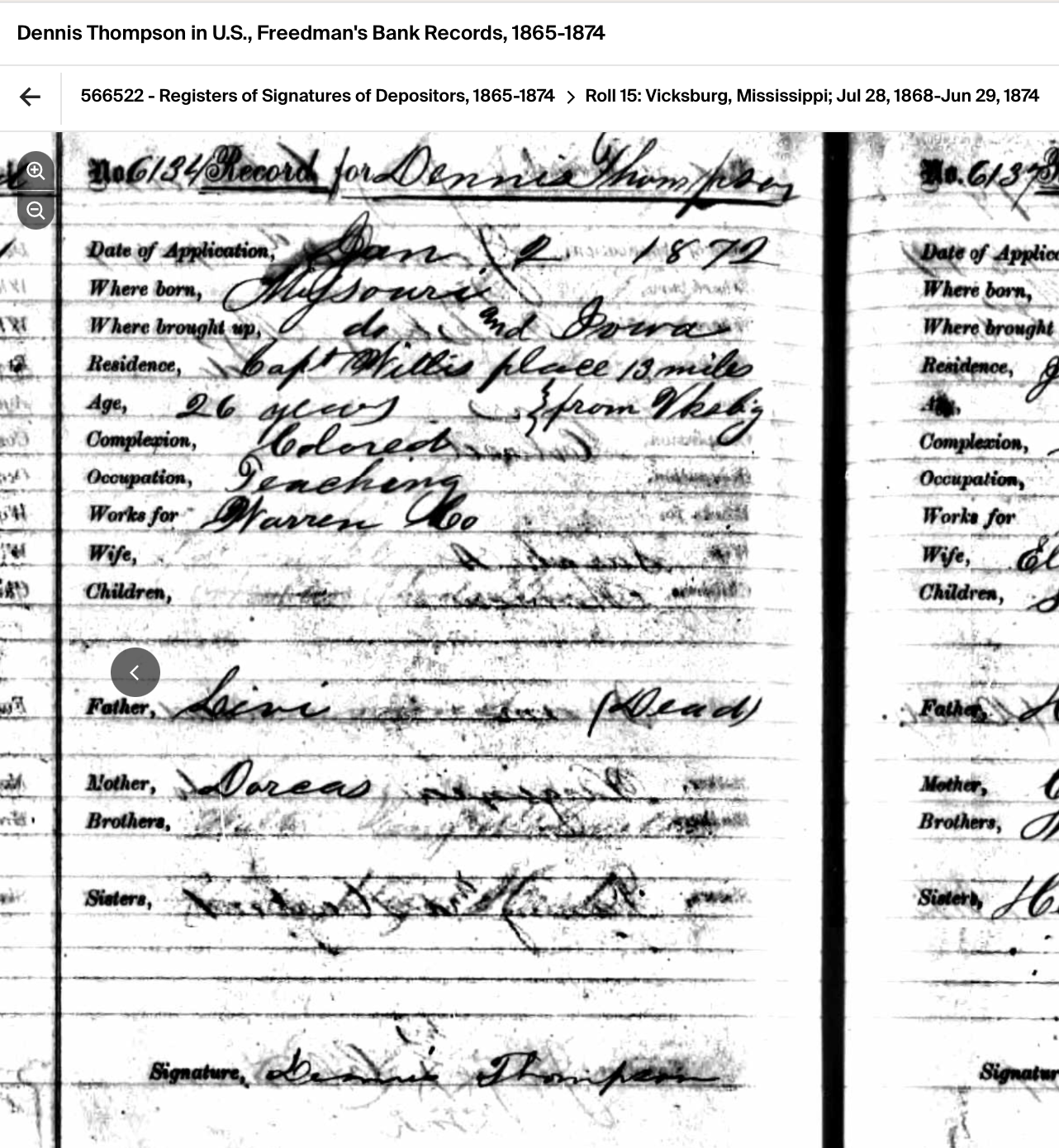
Transcription:
| Name | Dennis Thompson |
|---|---|
| Gender | Male |
| Residence Age | 26 |
| Application Age | 26 |
| Birth Date | abt 1846 |
| Birth Place | Missouri |
| Account Date | 2 Jan 1872 |
| Residence Address | Capt Willis Place 13 Miles From Vksbg |
| Residence | Mississippi |
| Last Known Residence | Missouri and Iowa |
| Application Date | 2 Jan 1872 |
| Bank Location | Vicksburg, Warren, Mississippi, USA |
| Works For | Warren Co. |
| Relation to Head | Self (Head) |
| Complexion | Colored |
| Occupation | Teacher |
| Father | Levi Thompson |
| Mother | Dorcas Thompson |
| Description | Roll 15: Vicksburg, Mississippi; Jul 28, 1868-Jun 29, 1874 |
| Account Number | 6134 |
|